
What Is a Circular Economy and Why Are Businesses Talking About It in 2026?
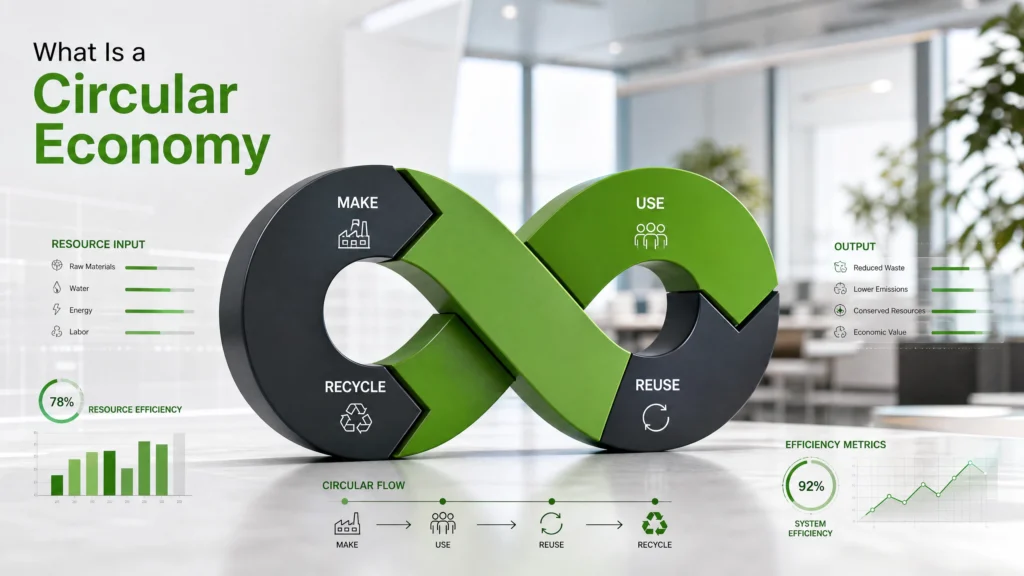
Many people are searching what is circular economy as businesses around the world begin to rethink how resources are used, reused, and managed. In 2026, this concept is becoming more important because companies are under pressure to reduce waste, improve efficiency, and operate more sustainably.
Unlike traditional business models that rely on a straight path of production and disposal, the circular economy introduces a system where materials and resources are kept in use for as long as possible.
This shift is changing how businesses design products, manage waste, and think about long term value.
What Is a Circular Economy?
A circular economy is a business system that focuses on reducing waste and reusing resources instead of discarding them after use.
In a traditional model, products follow a simple path:
Make → Use → Dispose
In a circular economy, the model changes:
Make → Use → Reuse → Repair → Recycle → Regenerate
The goal is to keep resources within the system for as long as possible.
This reduces waste and increases the value extracted from materials.
Why Businesses Are Moving Toward Circular Models
Many businesses are adopting circular economy principles because traditional systems are becoming less efficient.
Raw materials are becoming more expensive.
Waste management costs are increasing.
Consumers are becoming more environmentally aware.
Regulations in many regions are also encouraging more sustainable practices.
As a result, businesses are looking for ways to reduce dependence on constant raw material consumption.
The circular economy offers a practical solution.
The Problem With the Traditional Linear Model
The traditional “take, make, dispose” model creates long term inefficiencies.
Products are designed for short life cycles.
Materials are often discarded after single use.
Waste increases continuously.
Over time, this creates environmental and financial pressure.
Businesses lose value when materials are not reused or recovered.
This is one of the main reasons companies are rethinking their systems in 2026.
Key Principles of a Circular Economy
A circular economy is built on a few important principles:
Design out waste and pollution
Keep products and materials in use
Regenerate natural systems
These principles focus on reducing unnecessary waste and improving how resources are managed throughout the product lifecycle.
Instead of treating waste as the end result, circular systems try to prevent waste from being created in the first place.
How Businesses Apply Circular Economy Ideas
Businesses apply circular economy thinking in different ways.
Some focus on designing products that last longer.
Others create systems for repairing and reusing materials.
Some companies recycle materials back into production processes.
Others redesign supply chains to reduce waste from the beginning.
Even small improvements in efficiency can contribute to circular practices.
Benefits of a Circular Economy for Businesses
A circular economy can create several advantages for businesses.
It helps reduce production costs over time.
It improves resource efficiency.
It reduces waste management expenses.
It creates opportunities for innovation.
It can also improve brand reputation as consumers become more conscious of sustainability.
Businesses that adopt circular practices often find long term operational benefits.
Challenges of Implementing Circular Systems
Despite its benefits, implementing a circular economy is not always easy.
It may require redesigning products and processes.
Supply chains may need adjustments.
Initial costs can be high in some cases.
Businesses may also need new systems for tracking materials and waste.
However, many organisations are finding that long term benefits outweigh short term challenges.
Why the Circular Economy Matters in 2026
The circular economy is gaining attention in 2026 because global businesses are under pressure to improve sustainability performance.
Companies are being asked not only to reduce harm but to create systems that actively improve resource use.
This shift reflects a broader change in business thinking.
Efficiency, sustainability, and profitability are becoming more connected.
Where NatureSynth Fits
As businesses explore more efficient and sustainable systems, understanding operational waste becomes increasingly important.
NatureSynth helps businesses identify inefficiencies, understand resource patterns, and improve operational performance.
Better visibility often leads to better decisions and more efficient systems.
Small improvements can support long term sustainability goals.
Conclusion
The circular economy represents a shift from wasteful systems to more efficient and sustainable business models.
Instead of simply producing and discarding, businesses are learning to reuse, repair, and optimise resources.
In 2026, this approach is becoming more important as companies look for ways to balance growth with efficiency.
Next Step
Take a closer look at your business system.
Ask:
Where does waste occur?
What can be reused or improved?
How can resources be used more efficiently?
Better systems often create better outcomes.