
The Hidden Costs of Inefficiency: What Businesses Often Overlook
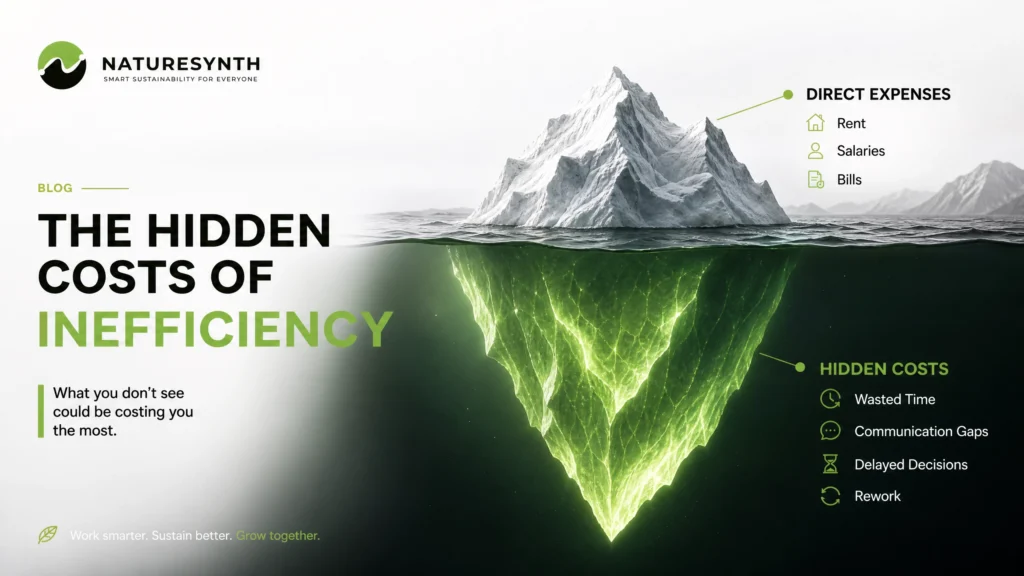
Every business pays attention to obvious expenses.
Rent appears on monthly statements. Salaries are carefully budgeted. Fuel costs, utility bills, inventory purchases, and equipment expenses are all visible and easy to track.
Because these costs are measurable, they often receive the most attention from business leaders.
However, some of the most expensive costs in business rarely appear on financial statements. They operate quietly in the background, reducing productivity, increasing expenses, and slowing growth.
These are the hidden costs of inefficiency.
While they may not always be obvious, their impact can be significant over time.
Understanding Business Inefficiency
Business inefficiency occurs when resources are not being used effectively.
This may involve wasted time, duplicated effort, unnecessary processes, poor communication, or delays in decision-making.
Unlike direct expenses, inefficiencies often accumulate gradually. Because they develop over time, organisations may fail to recognise their true impact.
A business can appear busy and active while quietly losing valuable resources every day.
The Cost of Wasted Time
Time is one of the most valuable resources available to any organisation.
When employees spend hours searching for information, repeating tasks, correcting avoidable mistakes, or waiting for approvals, productivity suffers.
Although these delays may seem minor individually, they create substantial losses when repeated across teams and departments.
For example, if ten employees lose just thirty minutes each day due to inefficient processes, the business loses five hours of productive work daily.
Over weeks and months, the cost becomes significant.
Rework and Correcting Mistakes
Mistakes are part of business operations, but repeated mistakes often indicate deeper inefficiencies.
When employees regularly redo work because of unclear instructions, poor communication, or inadequate systems, businesses pay for the same task multiple times.
Rework increases labour costs, delays projects, and reduces overall efficiency.
It also affects employee morale, as workers become frustrated by spending time fixing avoidable errors instead of moving work forward.
Communication Gaps and Their Impact
Poor communication is one of the most common sources of hidden costs.
Important information may be delayed, misunderstood, or lost entirely.
When communication breaks down, organisations experience:
Project delays
Missed deadlines
Duplicated efforts
Customer dissatisfaction
Reduced collaboration
These issues often create operational friction that slows business performance without attracting immediate attention.
Delayed Decision-Making
Many businesses underestimate the cost of slow decisions.
When decisions are delayed unnecessarily, opportunities may be lost, projects may stall, and teams may become less productive.
In some organisations, approvals move through multiple layers before action can occur.
While oversight is important, excessive delays can reduce agility and competitiveness.
In fast-moving markets, delayed decisions often carry hidden financial consequences.
Resource Waste Beyond Financial Costs
Waste is often associated with materials or inventory, but it extends much further.
Businesses can waste:
Employee effort
Energy
Operational capacity
Equipment usage
Management attention
When resources are not used effectively, costs increase without creating additional value.
Reducing waste is not only an environmental goal. It is also a business performance strategy.
Employee Burnout and Productivity Loss
Inefficient systems often place unnecessary pressure on employees.
When workers constantly deal with confusion, repeated problems, or inefficient workflows, productivity declines.
Over time, this can contribute to:
Lower engagement
Reduced job satisfaction
Increased turnover
Higher recruitment and training costs
The hidden cost of inefficiency is not limited to operations. It also affects people.
Missed Growth Opportunities
Perhaps one of the most overlooked costs of inefficiency is opportunity loss.
When businesses spend excessive time managing operational problems, they have less time to focus on growth.
Opportunities for innovation, expansion, customer development, and strategic planning may be missed because resources are consumed by daily inefficiencies.
This cost rarely appears in financial reports, yet it can have a major impact on long-term success.
Why Hidden Costs Often Go Unnoticed
Hidden costs are difficult to identify because they are spread across multiple activities.
Unlike a utility bill or supplier invoice, inefficiencies rarely arrive as a single expense.
Instead, they appear as:
Small delays
Minor errors
Repeated tasks
Unclear processes
Slow responses
Because these issues seem manageable individually, organisations often underestimate their combined impact.
Measuring What Matters
The first step toward reducing inefficiency is understanding where it exists.
Businesses should regularly evaluate:
Workflow processes
Communication systems
Decision-making structures
Resource utilisation
Operational bottlenecks
Measuring performance helps reveal patterns that may otherwise remain hidden.
What gets measured is easier to improve.
Building More Efficient Operations
Improving efficiency does not always require major transformation.
In many cases, small improvements can produce meaningful results.
Examples include:
Simplifying workflows
Reducing unnecessary approvals
Improving communication channels
Clarifying responsibilities
Using data more effectively
Over time, these changes can reduce waste, improve productivity, and strengthen business performance.
Where NatureSynth Fits
Many organisations recognise that inefficiencies exist but struggle to identify where they occur or how they affect performance.
NatureSynth helps businesses gain clearer visibility into operational patterns, identify areas of waste, and support better decision-making through actionable insights.
Understanding inefficiencies is the first step toward reducing them.
Small improvements can create lasting operational benefits.
Conclusion
The most expensive business costs are not always the ones that appear on financial statements.
Hidden inefficiencies quietly consume time, resources, energy, and opportunities every day.
While these costs may be difficult to see, their impact can be substantial.
Businesses that actively identify and address inefficiencies are often better positioned to improve productivity, reduce waste, and achieve sustainable growth.
The question is not whether inefficiencies exist.
The question is whether they are being recognised and addressed.
Next Step
Take a closer look at your organisation.
Where is time being lost?
Which processes create repeated frustration?
What inefficiencies have become accepted as normal?
The answers may reveal costs that have been hidden in plain sight.