
The Difference Between Being Busy and Being Productive in Business
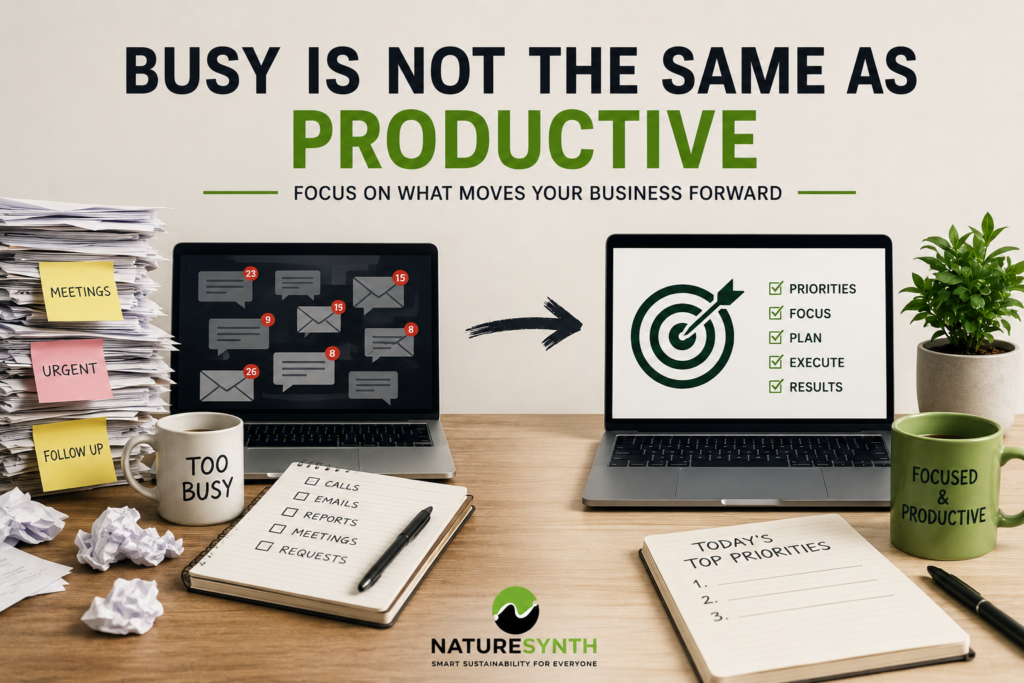
In many organisations, especially in fast-paced environments, busyness is often mistaken for productivity. Employees are constantly engaged in tasks, responding to messages, attending meetings, and handling daily operational demands.
On the surface, this creates an impression of progress.
However, being busy is not the same as being productive.
Understanding this difference is essential for improving business performance and achieving sustainable growth.
The Illusion of Busyness
Busyness gives the feeling of movement. There is always something happening, someone working, or an issue being addressed.
But movement does not always translate to meaningful progress.
A business can appear active while achieving very little in terms of long-term outcomes.
This illusion is common in organisations where activity is not clearly connected to results.
What Productivity Actually Means
Productivity is not about how much work is being done. It is about how effectively that work contributes to desired outcomes.
A productive system focuses on:
Clear objectives
Efficient use of time and resources
Meaningful outputs
Measurable progress
In simple terms, productivity is not about effort alone. It is about impact.
Why Businesses Become Busy but Not Productive
One of the main reasons businesses fall into the busyness trap is lack of clarity in priorities.
When everything is treated as urgent, nothing becomes truly important.
This leads to:
Constant task switching
Frequent interruptions
Unstructured workflows
Repetitive activities without clear goals
Over time, teams become occupied but not effective.
The Cost of Constant Activity
High activity levels often create hidden costs within organisations.
Employees may feel overworked, but output remains low.
This happens because energy is spread across too many tasks that do not contribute significantly to overall goals.
The result is:
Lower efficiency
Reduced focus
Increased stress
Minimal strategic progress
Busyness consumes energy without necessarily producing value.
Meetings, Messages, and Operational Noise
Modern workplaces often struggle with communication overload.
Meetings, emails, chats, and updates are essential for coordination, but they can also become distractions when not properly managed.
When too much time is spent on communication instead of execution, productivity declines.
The business becomes reactive rather than proactive.
Lack of Clear Measurement
Another reason businesses remain busy instead of productive is the absence of clear performance measurement.
Without defined indicators, it becomes difficult to determine whether work is actually contributing to progress.
In such environments, effort is often mistaken for achievement.
Measuring outcomes rather than activity is key to improving productivity.
Task Completion vs Value Creation
Not all completed tasks add value to a business.
Some tasks are necessary for operations, while others directly contribute to growth.
Productive organisations focus more on value creation than task completion alone.
This means prioritising work that improves efficiency, increases revenue, or strengthens operations.
The Role of Systems in Productivity
Strong systems help organisations move from busyness to productivity.
Systems ensure that:
Workflows are structured
Responsibilities are clear
Processes are efficient
Effort is directed toward meaningful outcomes
Without systems, productivity depends on individual effort rather than organisational design.
Why Employees Stay Busy
Employees are often busy because the structure of work demands constant attention.
This can happen when:
There is no clear prioritisation
Processes are inefficient
Tasks are poorly distributed
Urgent issues dominate planning
In such cases, employees are reacting to work instead of managing it effectively.
The Importance of Focus
Focus is one of the most important elements of productivity.
When attention is divided across too many tasks, performance declines.
Focused work allows individuals and teams to:
Complete tasks faster
Improve quality
Reduce errors
Achieve better outcomes
Focus transforms effort into results.
From Activity-Based to Outcome-Based Work
Many organisations still measure performance based on activity.
However, modern business performance is shifting toward outcomes.
Instead of asking how much work was done, the more important question is what results were achieved.
This shift helps organisations prioritise meaningful work over constant activity.
How to Improve Productivity in Business
Improving productivity does not always require major changes.
Small adjustments can make a significant difference:
Clarifying priorities
Reducing unnecessary meetings
Simplifying workflows
Eliminating repetitive tasks
Improving communication clarity
These changes help reduce busyness and increase meaningful output.
Where NatureSynth Fits
Many organisations remain busy because they lack clear visibility into how work flows across their systems.
NatureSynth helps businesses identify inefficiencies, understand operational patterns, and improve decision-making through clearer insights.
Better visibility supports better focus, which leads to improved productivity.
Small improvements in structure and clarity can significantly enhance performance.
Conclusion
Being busy is not the same as being productive.
While busyness reflects activity, productivity reflects impact.
Businesses that focus only on activity risk wasting time and resources without achieving meaningful progress.
The real goal is not to do more work, but to do the right work effectively.
Next Step
Look closely at your organisation.
Are your teams busy or productive?
How much of daily work contributes directly to meaningful outcomes?
Where is time being spent without clear impact?
Improving productivity begins with shifting focus from activity to results.