
Why Sustainability Should Be Discussed in Every Board Meeting
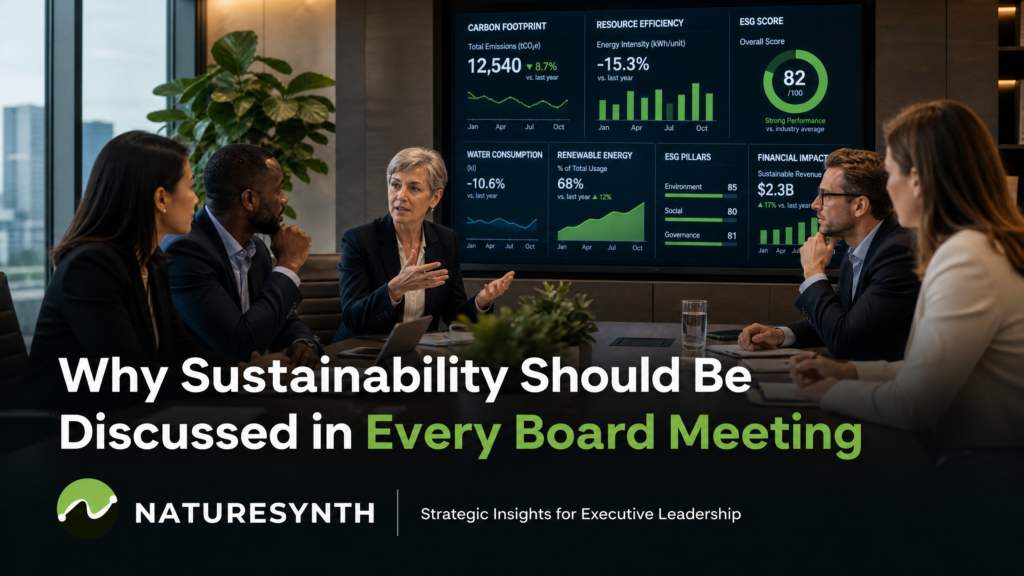
For many organisations, board meetings focus on financial performance, operational updates, market trends, and business risks. These discussions are essential because they influence the strategic direction of the organisation.
However, one topic is still missing from many boardroom conversations: sustainability.
Some leaders continue to view sustainability as an operational issue or a responsibility for a dedicated ESG team. In reality, sustainability influences strategy, risk management, reputation, innovation, and long-term value creation. Consequently, organisations that overlook sustainability at the highest level may also overlook emerging opportunities and risks.
Therefore, sustainability strategy deserves a permanent place on every board meeting agenda.
Sustainability Is a Strategic Business Issue
Sustainability is no longer limited to environmental initiatives.
Today, it influences how organisations manage resources, govern their operations, support employees, engage with communities, and prepare for future challenges.
As a result, sustainability decisions affect business performance just as much as financial or operational decisions.
When boards treat sustainability as a strategic priority, they position their organisations to respond more effectively to changing market conditions and stakeholder expectations.
Boards Shape Long-Term Direction
A board’s primary responsibility is to guide the long-term success of an organisation.
That responsibility extends beyond reviewing quarterly financial results.
It also includes identifying future risks, evaluating growth opportunities, and ensuring responsible governance.
Because sustainability affects each of these areas, it should be discussed alongside investment decisions, expansion plans, and organisational performance.
Consequently, integrating sustainability strategy into board discussions strengthens long-term planning.
Sustainability Helps Organisations Manage Risk
Businesses operate in an increasingly complex environment.
Climate-related disruptions, resource constraints, changing regulations, cybersecurity concerns, and evolving customer expectations all create new risks.
Furthermore, investors and regulators increasingly expect organisations to demonstrate responsible governance and sustainable business practices.
Boards that regularly review sustainability issues are better equipped to identify potential risks before they become costly problems.
Therefore, sustainability discussions improve organisational resilience.
Better Decisions Require Broader Perspectives
Effective board decisions consider more than immediate financial outcomes.
They also examine how today’s choices will affect employees, customers, suppliers, communities, and future business performance.
Sustainability encourages leaders to evaluate these broader impacts.
Additionally, it promotes balanced decision-making by considering both short-term performance and long-term value creation.
As a result, organisations become more adaptable and better prepared for future challenges.
Investors Are Paying Attention
Investment priorities continue to evolve.
Many investors now evaluate governance, environmental performance, and social responsibility alongside financial results.
Although profitability remains important, sustainable business practices increasingly influence investment confidence.
Boards that actively discuss sustainability demonstrate that they understand these changing expectations.
Consequently, organisations strengthen their credibility with investors and other stakeholders.
Sustainability Drives Innovation
Board meetings often focus on growth opportunities.
Sustainability can contribute significantly to those discussions.
Improving resource efficiency, adopting cleaner technologies, developing sustainable products, and strengthening supply chains can all create competitive advantages.
Moreover, organisations that encourage sustainable innovation are often better positioned to respond to changing customer needs.
Therefore, sustainability supports both operational improvement and business growth.
Governance and Sustainability Go Hand in Hand
Strong governance provides the structure that enables sustainability to succeed.
Clear accountability, transparent reporting, ethical leadership, and responsible oversight all support effective sustainability initiatives.
Without board engagement, sustainability efforts may remain isolated within individual departments.
However, when boards champion sustainability strategy, sustainability becomes embedded throughout the organisation.
This alignment strengthens both governance and business performance.
Practical Questions Every Board Should Ask
Rather than discussing sustainability only once each year, boards should include it in regular strategic conversations.
Useful questions include:
- Are our sustainability goals aligned with our business strategy?
- Which sustainability risks could affect future performance?
- Are we measuring meaningful sustainability outcomes?
- How can sustainability improve operational efficiency?
- What opportunities exist for innovation and long-term value creation?
- Are we meeting stakeholder expectations?
These discussions encourage informed decision-making and continuous improvement.
Where NatureSynth Fits
Strong sustainability decisions begin with reliable information.
NatureSynth helps organisations transform sustainability data into practical business insights that support strategic planning, governance, and performance improvement.
By providing clear visibility into sustainability performance, NatureSynth enables leaders to make informed decisions that strengthen resilience, improve efficiency, and create long-term value.
As a result, sustainability becomes an integral part of organisational strategy rather than a separate initiative.
Conclusion
Board meetings shape the future of every organisation.
The topics discussed today influence tomorrow’s performance, resilience, and reputation.
Sustainability is no longer a peripheral issue.
It is a strategic business consideration that affects governance, risk management, operational performance, innovation, and stakeholder trust.
By making sustainability strategy a standing agenda item, boards demonstrate a commitment to responsible leadership and long-term success.
Ultimately, organisations that discuss sustainability consistently are better positioned to thrive in an increasingly complex business environment.
Next Step
At your next board or leadership meeting, ask one simple question:
If sustainability is critical to our long-term success, why isn’t it part of every strategic conversation?
The answer could shape the future of your organisation.