
The Hidden Cost of Ignoring Sustainability in Business
Many business leaders still view sustainability as an environmental initiative rather than a business strategy.
As a result, sustainability is often treated as something to consider later, after revenue grows or market conditions improve. However, delaying sustainability efforts can expose organisations to risks that are far more expensive than the investments required to prevent them.
Today’s business environment is changing rapidly. Customers are making more informed choices, investors are paying closer attention to Environmental, Social, and Governance (ESG) performance, and regulators are introducing higher expectations for accountability. Consequently, businesses that ignore sustainability may find themselves losing opportunities they never realised existed.
Therefore, business sustainability is no longer a desirable addition to corporate strategy. It has become an essential driver of long-term resilience and competitiveness.
Sustainability Is More Than Environmental Responsibility
Many people associate sustainability with recycling, renewable energy, or reducing carbon emissions.
Although these initiatives remain important, business sustainability extends much further.
It includes responsible governance, ethical leadership, efficient resource management, employee well-being, operational resilience, and long-term value creation.
Rather than focusing only on short-term financial performance, sustainable businesses consider how today’s decisions will influence tomorrow’s success.
Consequently, sustainability becomes part of everyday business strategy instead of a separate programme.
Inefficiency Has a Financial Cost
Every organisation aims to improve profitability.
Nevertheless, hidden inefficiencies often reduce financial performance without attracting immediate attention.
Energy waste, excessive water consumption, unnecessary material losses, and inefficient operational processes all increase costs.
Similarly, outdated systems can reduce productivity while limiting an organisation’s ability to compete.
Over time, these inefficiencies accumulate into significant financial losses.
Therefore, improving resource efficiency is not only environmentally responsible but also financially beneficial.
Reputation Takes Years to Build and Moments to Lose
Trust is one of the most valuable assets any organisation can possess.
Customers increasingly expect businesses to operate responsibly and communicate transparently.
Likewise, investors and business partners are paying greater attention to ethical conduct and governance practices.
When organisations fail to meet these expectations, reputational damage can occur quickly.
Although rebuilding trust is possible, it often requires substantial time and investment.
As a result, business sustainability plays a critical role in protecting organisational credibility.
Employees Want More Than Competitive Salaries
People are central to every successful organisation.
While competitive compensation remains important, employees also value safe workplaces, ethical leadership, professional development, and a positive organisational culture.
Businesses that neglect these areas often experience higher staff turnover, lower engagement, and reduced productivity.
Conversely, organisations that invest in employee well-being frequently build stronger, more committed teams.
Consequently, sustainability contributes directly to workforce stability and organisational performance.
Customers Are Changing Their Expectations
Consumers today have greater access to information than ever before.
Many now consider how businesses operate before deciding where to spend their money.
Transparency, ethical sourcing, responsible governance, and environmental responsibility increasingly influence purchasing decisions.
Although price and quality remain important, trust has become another competitive advantage.
Businesses that demonstrate responsible practices are therefore better positioned to build lasting customer relationships.
Investors Are Looking Beyond Financial Results
Investment decisions are evolving.
Increasingly, investors seek organisations capable of managing long-term risks alongside financial performance.
Strong governance, responsible environmental practices, and effective people management can indicate whether a business is prepared for future challenges.
Consequently, sustainability performance has become an important consideration for many investment decisions.
Organisations that ignore these expectations may limit their access to future opportunities.
Sustainability Strengthens Business Resilience
Every business faces uncertainty.
Economic fluctuations, supply chain disruptions, changing regulations, and climate-related events can affect operations.
While no organisation can eliminate every risk, sustainable businesses are often better prepared to respond.
Effective governance improves decision-making.
Resource efficiency reduces operational costs.
Healthy workplace cultures strengthen organisational resilience.
Together, these elements enable businesses to adapt more effectively as circumstances change.
Practical Steps Towards Business Sustainability
Building a sustainable business does not require immediate transformation.
Instead, organisations can begin with practical improvements.
These include:
- Identifying operational inefficiencies.
- Setting measurable sustainability objectives.
- Improving energy and resource efficiency.
- Strengthening governance and accountability.
- Investing in employee well-being.
- Monitoring sustainability performance regularly.
- Embedding sustainability into strategic planning.
Although progress may occur gradually, consistent improvement creates lasting value.
Where NatureSynth Fits
Making sustainability decisions requires more than good intentions.
Organisations also need reliable data and meaningful insights.
NatureSynth helps businesses understand their sustainability performance by providing intelligence that supports informed decision-making, resource optimisation, and continuous improvement.
By transforming data into actionable insights, NatureSynth enables organisations to identify risks, improve efficiency, strengthen ESG performance, and build long-term resilience.
Consequently, sustainability becomes measurable, strategic, and closely aligned with business objectives.
Conclusion
Ignoring sustainability may appear to reduce costs in the short term.
However, the long-term consequences often prove far more expensive.
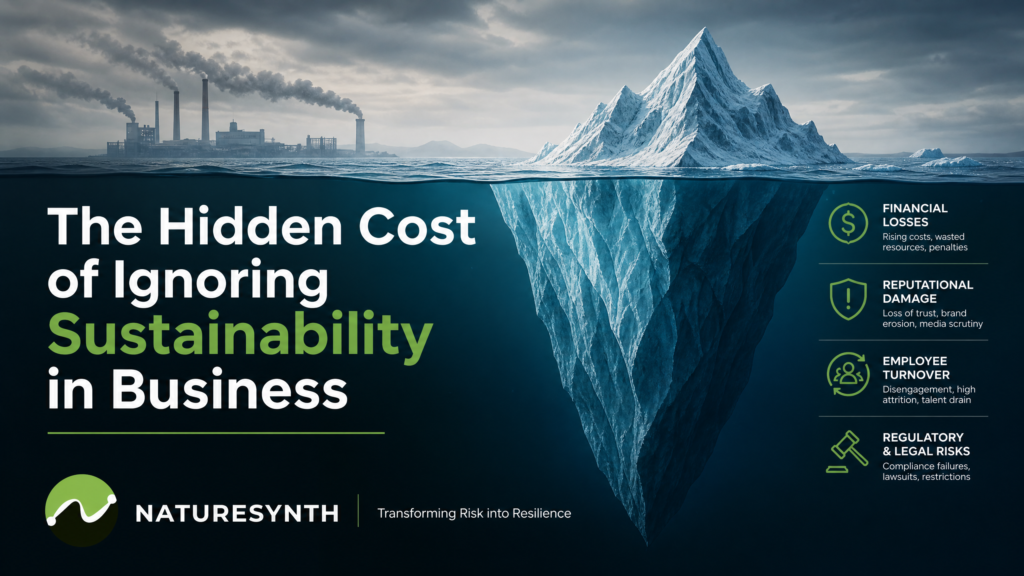
Operational inefficiencies, reputational damage, employee turnover, regulatory pressures, and lost investment opportunities can all affect organisational performance.
By embracing business sustainability, organisations position themselves for stronger growth, greater resilience, and lasting competitive advantage.
Ultimately, sustainable businesses are not simply preparing for tomorrow’s challenges.
They are creating tomorrow’s opportunities.
Next Step
Ask yourself one important question:
If your organisation continues operating exactly as it does today for the next five years, will it become more resilient—or more vulnerable?
The answer may reveal why investing in business sustainability today is one of the smartest decisions any organisation can make.