
Why Growing Revenue Doesn’t Always Increase Profit
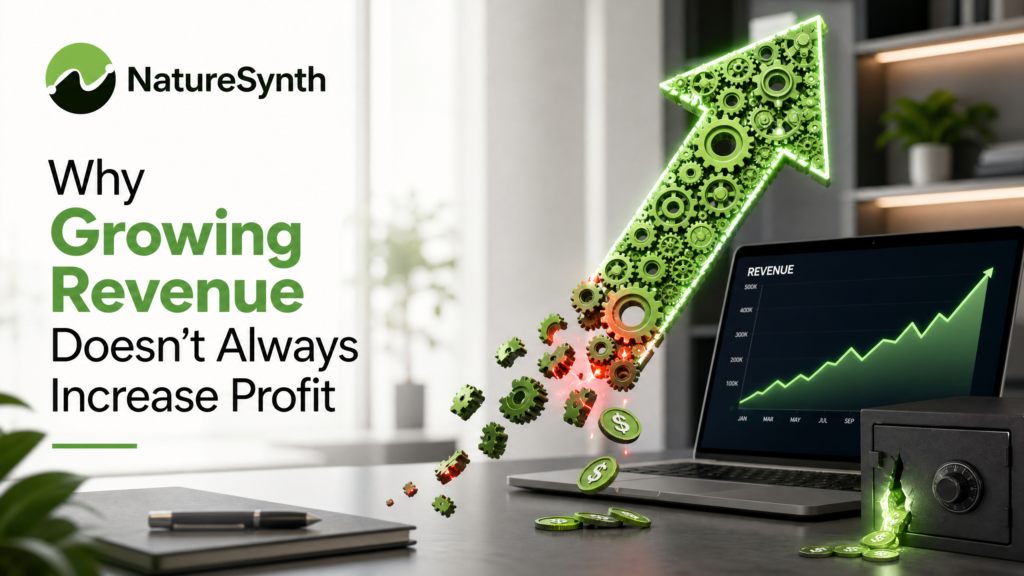
Many business owners view revenue growth as the ultimate sign of success.
After all, increasing sales often indicates that demand is rising, customers are buying, and the business is expanding. However, revenue tells only part of the story.
A company can generate more revenue while earning less money.
In fact, some organisations experience significant growth yet struggle with declining profitability. Therefore, understanding the relationship between revenue and business profit is essential for sustainable success.
While revenue measures how much money enters a business, profit reflects how much remains after expenses have been paid.
That difference matters more than many organisations realise.
Revenue and Business Profit Are Not the Same
Revenue and business profit are often discussed together. Nevertheless, they represent different financial realities.
Revenue refers to the total income generated from products or services.
Business profit, on the other hand, is what remains after operating costs, salaries, technology expenses, rent, taxes, and other expenditures have been deducted.
As a result, a business can increase revenue while seeing little improvement in profit.
Consequently, focusing exclusively on sales figures can create a misleading picture of performance.
Growth Often Brings New Costs
Many businesses expect profitability to increase automatically as revenue grows.
However, expansion frequently introduces additional expenses.
New employees may be hired. Furthermore, larger operations often require more technology, equipment, office space, and administrative support.
Customer service demands may also increase.
Meanwhile, marketing costs can rise as businesses compete for larger market shares.
Although revenue grows, these additional expenses can absorb much of the financial gain.
Therefore, growth does not always translate into stronger business profit.
Operational Inefficiency Can Reduce Profitability
Even successful businesses can struggle with inefficiencies.
For example, outdated workflows may slow operations. Similarly, poor communication can create delays that affect productivity.
These inefficiencies often increase operating costs without creating additional value.
As a result, the organisation spends more money to achieve the same outcomes.
Over time, operational inefficiency becomes a significant threat to business profit.
The impact may not be immediately visible, but it gradually affects financial performance.
Rework Creates Hidden Expenses
Many organisations underestimate the cost of rework.
When tasks must be corrected, revised, or repeated, additional time and resources are consumed.
Consequently, labour costs increase while productivity declines.
Furthermore, repeated work often delays other important activities.
Although rework may not appear as a major expense on financial statements, its cumulative effect can significantly reduce business profit.
This is one reason profitable growth requires attention to operational quality as well as revenue generation.
Customer Acquisition Can Become Expensive
Winning new customers is important for growth.
However, customer acquisition often carries substantial costs.
Advertising campaigns, promotional activities, sales teams, and marketing technology all require investment.
If acquisition costs rise faster than customer value, profitability may suffer.
Therefore, businesses should evaluate not only how many customers they attract but also how efficiently they acquire them.
A growing customer base is valuable. Nevertheless, sustainable business profit depends on maintaining healthy acquisition economics.
Scaling Can Increase Complexity
Growth usually increases operational complexity.
Additional customers generate more transactions. Likewise, larger teams require greater coordination.
Communication channels multiply. Decision-making processes become more complicated.
Consequently, businesses often experience new challenges as they scale.
Without strong systems, these challenges can increase costs faster than revenue.
As a result, organisations may grow larger while becoming less profitable.
This is why scalability depends on operational readiness rather than growth alone.
Why Revenue Metrics Can Be Misleading
Revenue figures are highly visible.
Investors, managers, and stakeholders frequently celebrate rising sales numbers.
However, revenue does not reveal how efficiently a business operates.
Two companies may generate identical revenue while producing vastly different levels of business profit.
One organisation may control costs effectively. Meanwhile, the other may struggle with waste and inefficiency.
Therefore, profitability provides a more complete picture of financial health.
Businesses should evaluate both metrics rather than focusing on revenue alone.
Improving Business Profit Through Efficiency
Many organisations attempt to increase profit by pursuing additional sales.
While revenue growth remains important, efficiency improvements often create equally valuable opportunities.
Reducing unnecessary costs can strengthen profitability without increasing customer demand.
For example, businesses can improve business profit by:
- Streamlining workflows
- Reducing rework
- Eliminating operational bottlenecks
- Improving communication
- Optimising resource allocation
- Strengthening decision-making processes
These improvements help organisations retain more value from existing operations.
Consequently, profitability increases in a sustainable manner.
Visibility Supports Better Financial Decisions
Leaders cannot improve what they cannot see.
Therefore, visibility plays a critical role in profitability management.
Businesses need accurate information regarding operational performance, resource utilisation, and cost drivers.
Without visibility, hidden inefficiencies often remain unnoticed.
Meanwhile, expenses continue to accumulate.
Access to reliable data helps organisations identify opportunities to strengthen business profit before problems become larger challenges.
Where NatureSynth Fits
Many organisations focus heavily on revenue growth but struggle to understand the operational factors affecting profitability.
NatureSynth helps businesses gain clearer visibility into performance, uncover inefficiencies, and support better decision-making through actionable insights.
As a result, leaders can identify hidden costs, improve operational efficiency, and strengthen business profit over time.
Small operational improvements often generate significant financial benefits.
Conclusion
Revenue growth is an important indicator of business activity.
However, it does not automatically guarantee stronger financial performance.
Costs, inefficiencies, rework, complexity, and operational challenges can all reduce profitability even when sales are increasing.
Therefore, organisations should focus on both growth and efficiency.
Ultimately, sustainable success depends not only on generating more revenue but also on protecting and increasing business profit.
Next Step
Take a closer look at your organisation’s financial performance.
Are revenues increasing faster than costs?
Which operational activities consume the most resources?
Where do inefficiencies affect profitability?
The answers may reveal opportunities to improve business profit without relying solely on additional sales.