
Why Sustainability Is Becoming a Financial Decision, Not Just an Environmental One
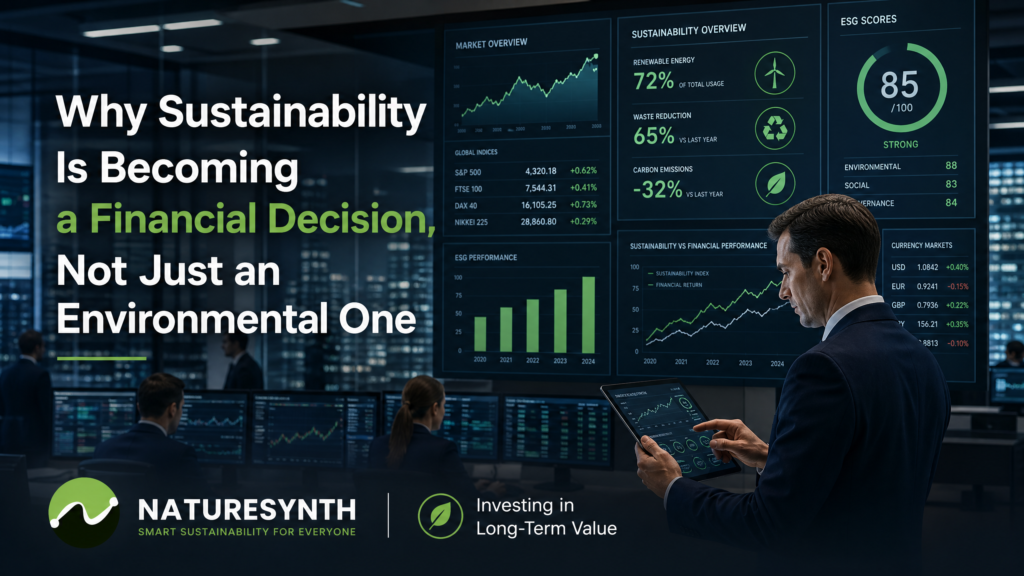
For many years, sustainability was viewed primarily as an environmental responsibility. Businesses associated it with reducing emissions, recycling waste, and supporting conservation initiatives. While these efforts remain important, they represent only one part of the sustainability conversation.
Today, business leaders are approaching sustainability from a different perspective.
Rather than asking, “How does sustainability benefit the environment?” they are asking, “How does sustainability strengthen our business?”
The answer is becoming increasingly clear. Business sustainability is no longer simply an environmental consideration. It is a financial decision that influences costs, operational efficiency, investment opportunities, risk management, and long-term profitability.
Sustainability Protects the Bottom Line
Every business aims to improve profitability.
One of the most effective ways to achieve this is by reducing unnecessary costs.
Businesses that improve energy efficiency, minimise waste, optimise resource use, and streamline operations often lower their operating expenses while improving productivity.
Although these improvements support environmental goals, they also deliver measurable financial benefits.
Consequently, sustainability becomes an investment in stronger financial performance rather than an additional expense.
Managing Risk Protects Business Value
Every organisation faces risks that can affect financial performance.
Supply chain disruptions, rising energy prices, changing regulations, resource shortages, and reputational challenges all have financial consequences.
Businesses that integrate sustainability into their decision-making are often better prepared to identify and manage these risks before they escalate.
As a result, they protect revenue, reduce unexpected costs, and improve long-term resilience.
Investors Are Looking Beyond Financial Statements
Investment decisions are evolving.
While financial performance remains important, investors increasingly evaluate how businesses manage environmental, social, and governance (ESG) issues.
Strong governance, responsible operations, and effective sustainability practices demonstrate that an organisation is preparing for future challenges.
Consequently, businesses with robust sustainability strategies often inspire greater investor confidence.
Customers Reward Responsible Businesses
Customers are becoming more selective about the organisations they support.
Many prefer businesses that operate responsibly, communicate transparently, and demonstrate genuine commitment to sustainable practices.
This trust influences purchasing decisions and encourages long-term customer loyalty.
Therefore, sustainability contributes not only to reputation but also to revenue growth.
Operational Efficiency Creates Competitive Advantage
Operational efficiency is one of the clearest financial benefits of sustainability.
Reducing waste, improving inventory management, conserving energy, and optimising logistics all contribute to lower operating costs.
Furthermore, efficient businesses are often more competitive because they can deliver greater value while using fewer resources.
Consequently, sustainability strengthens both profitability and operational performance.
Sustainability Encourages Better Decision-Making
Financial success depends on informed decisions.
Sustainability encourages organisations to consider long-term impacts alongside short-term results.
Instead of focusing exclusively on immediate profits, leaders evaluate how today’s decisions influence future growth, resilience, and stakeholder trust.
This broader perspective supports stronger strategic planning and more sustainable financial outcomes.
Sustainability Supports Long-Term Growth
Businesses that prioritise sustainability often position themselves for long-term success.
They are better prepared to adapt to changing regulations, evolving customer expectations, technological innovation, and market uncertainty.
Rather than reacting to change, these organisations anticipate it.
As a result, they build stronger foundations for sustainable growth and profitability.
Financial Performance and Sustainability Are Connected
One of the biggest misconceptions is that businesses must choose between profitability and sustainability.
In reality, these objectives often reinforce one another.
Reducing waste lowers costs.
Improving efficiency increases productivity.
Building trust strengthens customer relationships.
Managing risks protects financial performance.
Supporting employees improves innovation and retention.
Collectively, these outcomes contribute directly to stronger financial results.
Where NatureSynth Fits
Making sustainability a financial advantage begins with accurate data and practical insights.
NatureSynth helps organisations understand how sustainability affects business performance by transforming complex information into clear, actionable intelligence.
From identifying operational inefficiencies to supporting better governance and strategic planning, NatureSynth enables businesses to make informed decisions that create long-term value.
By integrating sustainability into everyday decision-making, organisations strengthen both financial performance and resilience.
Conclusion
Sustainability has evolved far beyond environmental responsibility.
It is now an essential component of financial strategy.
Businesses that embrace business sustainability reduce costs, manage risks more effectively, improve operational efficiency, strengthen stakeholder confidence, and position themselves for long-term success.
The organisations that view sustainability as a financial decision today will be better prepared to compete tomorrow.
Next Step
Ask yourself one important question:
Is your business treating sustainability as a cost—or as an investment in long-term financial success?
The answer may shape your organisation’s future.