
Why More Employees Don’t Always Increase Productivity
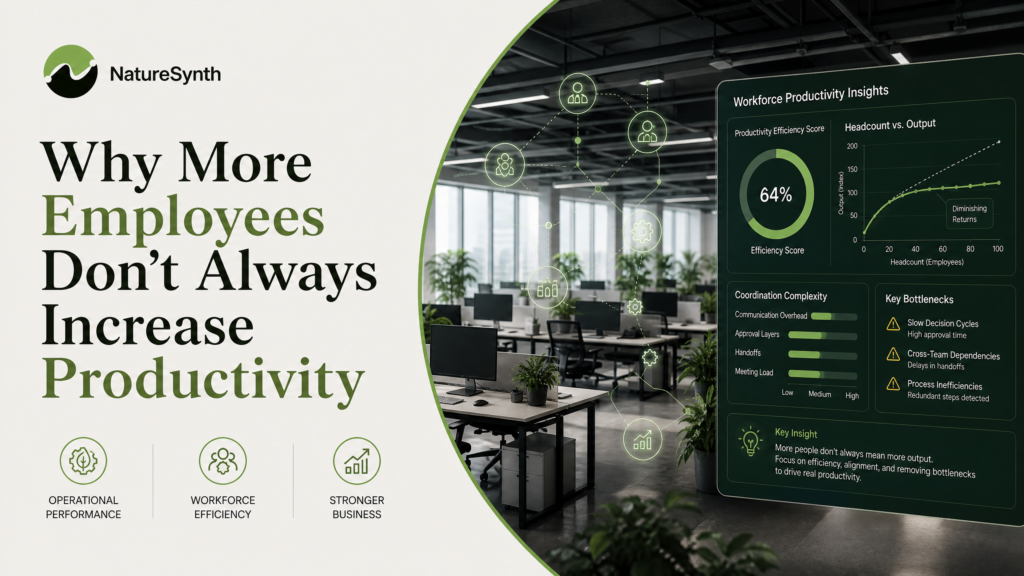
When business performance begins to slow, many organisations reach for an obvious solution: hire more people.
At first glance, the logic seems sound. More employees should mean more work completed, faster operations, and stronger results. However, the reality is often more complicated.
Many growing businesses discover that adding staff does not automatically improve employee productivity. In some cases, performance remains unchanged. In others, productivity may even decline.
Therefore, understanding the relationship between workforce size and operational performance is essential for sustainable growth.
The Common Assumption About Growth
Business leaders frequently associate growth with expansion. As customer demand increases, additional employees are brought in to handle the workload.
Although hiring can be necessary, workforce growth does not always solve underlying challenges.
For example, if inefficient processes already exist, adding more people may simply increase the number of individuals affected by those inefficiencies.
Consequently, the organisation becomes larger without becoming more productive.
More Employees Create More Complexity
As teams expand, coordination requirements increase.
Communication becomes more difficult. Responsibilities may overlap. Decision-making often slows because more people become involved in daily operations.
Meanwhile, managers spend additional time supervising, training, and supporting larger teams.
While each employee may work hard, the organisation itself may not become significantly more efficient.
As a result, overall employee productivity may improve less than expected.
Communication Challenges Grow With Team Size
Small teams often communicate informally.
Questions are answered quickly. Problems are identified early. Information moves easily between employees.
However, larger teams require more structured communication systems.
Without clear processes, important information can become delayed, misunderstood, or lost entirely.
Furthermore, communication breakdowns often create duplicate work, missed deadlines, and operational confusion.
Each of these factors can reduce employee productivity across the organisation.
The Hidden Cost of Additional Management
Hiring more employees often requires additional supervision.
New team members need onboarding, guidance, and performance management.
Similarly, managers must spend more time coordinating activities and resolving issues.
This management burden is frequently overlooked when businesses plan expansion.
Although the workforce grows, leadership resources become increasingly stretched.
Consequently, productivity gains may be smaller than anticipated.
Why Processes Matter More Than Headcount
Strong processes allow businesses to achieve more with existing resources.
By contrast, weak processes create inefficiencies regardless of team size.
Consider a business that relies on slow approval systems. Adding ten employees will not remove the approval delays.
Likewise, outdated workflows continue creating bottlenecks even when additional staff are available.
Therefore, improving systems often generates greater benefits than increasing headcount alone.
Technology Cannot Fix Every Productivity Problem
Many organisations combine hiring with new technology investments.
While technology can improve efficiency, it is not a guaranteed solution.
If processes remain poorly designed, software may simply automate inefficient activities.
Moreover, employees still require clear workflows, defined responsibilities, and effective communication.
Technology works best when it supports strong operational foundations.
When Hiring Actually Improves Employee Productivity
Additional employees can create substantial value when genuine capacity constraints exist.
For example, organisations may require more staff when:
- Demand consistently exceeds available capacity
- Employees are overloaded with work
- Specialised expertise is missing
- Growth creates legitimate resource gaps
Under these circumstances, hiring helps remove constraints that limit performance.
However, workforce expansion should address specific challenges rather than serve as a default response to every problem.
Improving Productivity Without Expanding Teams
Many businesses can improve employee productivity without increasing staff numbers.
Several approaches include:
- Simplifying workflows
- Reducing unnecessary approvals
- Improving communication systems
- Eliminating repetitive tasks
- Strengthening employee training
- Clarifying responsibilities
- Using data to identify inefficiencies
Because these improvements target root causes, they often deliver lasting results.
Furthermore, they help organisations scale more effectively over time.
Measuring What Truly Matters
Some businesses focus heavily on activity levels rather than outcomes.
Employees may appear busy throughout the day. Nevertheless, high activity does not always translate into meaningful results.
Effective organisations measure productivity based on performance, output quality, and operational outcomes.
Consequently, leaders gain a clearer understanding of what drives success and where improvements are needed.
Where NatureSynth Fits
Many organisations recognise productivity challenges but struggle to identify their underlying causes.
NatureSynth helps businesses gain greater visibility into operational performance, uncover inefficiencies, and support better decision-making through actionable insights.
As a result, leaders can identify opportunities to improve employee productivity without automatically increasing workforce size.
Better visibility often leads to smarter resource allocation and stronger operational performance.
Conclusion
Hiring more people can support growth. However, workforce expansion is not always the most effective way to improve employee productivity.
Processes, communication systems, decision-making structures, and operational visibility often have a greater influence on performance than headcount alone.
Therefore, organisations should examine how work is performed before assuming additional employees are required.
Ultimately, sustainable productivity comes from improving the system, not simply enlarging it.
Next Step
Take a closer look at your organisation.
Are productivity challenges caused by a lack of people?
Or are existing processes creating unnecessary barriers?
The answer may reveal opportunities to improve employee productivity without increasing costs or complexity.