
Nigerian MSMEs Are Taking Sustainability Steps, But Are They Measuring Their Progress?
Many Nigerian businesses are beginning to adopt sustainability practices. Some are investing in solar energy, others are improving waste management, while many are becoming more conscious of their energy and water consumption.
However, adopting sustainability practices does not automatically mean a business understands or measures its environmental and social performance.
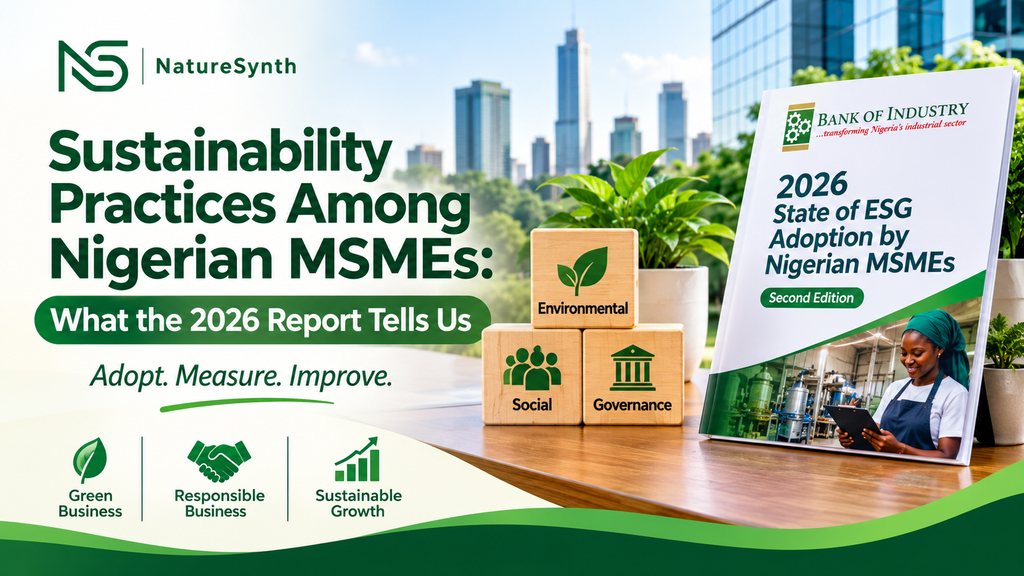
This distinction is highlighted in the Bank of Industry’s November 2026 report, 2026 State of ESG Adoption by Nigerian MSMEs, which examines sustainability awareness, business practices, climate risks and access to green finance among Nigerian micro, small and medium-sized enterprises.
The findings reveal an important challenge: businesses are taking steps towards sustainability, but many still lack the systems needed to measure their progress.
What Does the Report Reveal?
The report surveyed 530 MSMEs across Nigeria’s six geopolitical zones and found that 73% had adopted at least one environmental practice.
However, only 27% had an environmental policy, while just 14% reported on their ESG performance.
This suggests that sustainability activities are happening in many businesses without being properly documented or monitored.
For example, a business may install solar panels to reduce generator dependence. Another may introduce recycling practices or improve water management.
These are positive steps. But without tracking energy consumption, waste recovery or water use, it becomes difficult to determine how much progress has actually been made.
3 Areas Where Nigerian Businesses Need to Improve
1. Energy Management
Energy remains a major sustainability concern for Nigerian businesses.
According to the report, 50% of surveyed MSMEs rely on generators as a main energy source, while 35% use solar energy and 9% use hybrid systems.
Generator dependence can increase operating expenses and contribute to greenhouse gas emissions.
Businesses need to understand their energy consumption, identify inefficient equipment and evaluate alternatives that suit their operational requirements.
2. Waste Management
The report also highlights weaknesses in how businesses manage their waste.
Approximately 30% of surveyed enterprises reported dumping their waste, while another 30% recycled or reused materials.
This shows that there is still considerable room for improvement in waste recovery and resource efficiency.
Businesses can begin by identifying the types of waste they generate, separating recyclable materials and exploring opportunities to reuse resources within their operations.
3. Climate Risk Management
Climate-related disruptions are already affecting Nigerian businesses.
The report found that 79% of surveyed enterprises had experienced at least one climate event. Flooding affected 45%, while extreme heat affected 41%.
These events can disrupt transportation, damage facilities, affect employees and increase operating costs.
Businesses should therefore consider their exposure to climate risks when making operational and investment decisions.
Why Measuring Sustainability Performance Matters
One of the most important findings is the difference between adopting sustainability practices and measuring their outcomes.
A business may claim to be reducing its environmental impact, but without reliable records, it may struggle to demonstrate that improvement.
Measurement helps organisations understand their current position, identify weaknesses and determine whether their sustainability initiatives are producing meaningful results.
It also provides useful information for reporting, business planning and engagement with financial institutions.
NatureSynth previously explored this issue in its article on how to measure sustainability performance in business.
What Should Businesses Do Next?
Nigerian businesses do not need to introduce complicated sustainability systems immediately.
They can begin with a few practical steps:
- Record electricity and generator fuel consumption.
- Monitor water usage and identify unnecessary waste.
- Document waste generation, reuse and recycling activities.
- Identify climate risks that could affect business operations.
- Establish realistic sustainability targets.
- Review progress regularly and retain supporting evidence.
These actions can help businesses move from informal sustainability activities towards more structured and measurable improvements.
How NatureSynth Can Help
Understanding sustainability performance requires more than introducing individual environmental initiatives. Businesses need a clearer picture of their existing practices, the gaps that need attention and the improvements they can realistically make.
NatureSynth helps organisations assess their sustainability practices, organise supporting evidence and identify practical improvement priorities.
Through its structured assessment approach, businesses can better understand where they stand and determine what needs to happen next.
Explore NatureSynth to learn more about its sustainability assessment and improvement solutions.
Conclusion
The Bank of Industry’s 2026 report highlights an important reality about sustainability among Nigerian MSMEs.
Many businesses are already taking positive steps, but measuring and documenting those efforts remains a significant challenge.
The next stage should not simply be about adopting more sustainability practices. It should also involve understanding whether existing efforts are working, measuring their results and identifying where further improvements are needed.
Sustainability progress should not only be practised. It should also be measured and understood.