
Circular Economy 101: A Beginner’s Guide
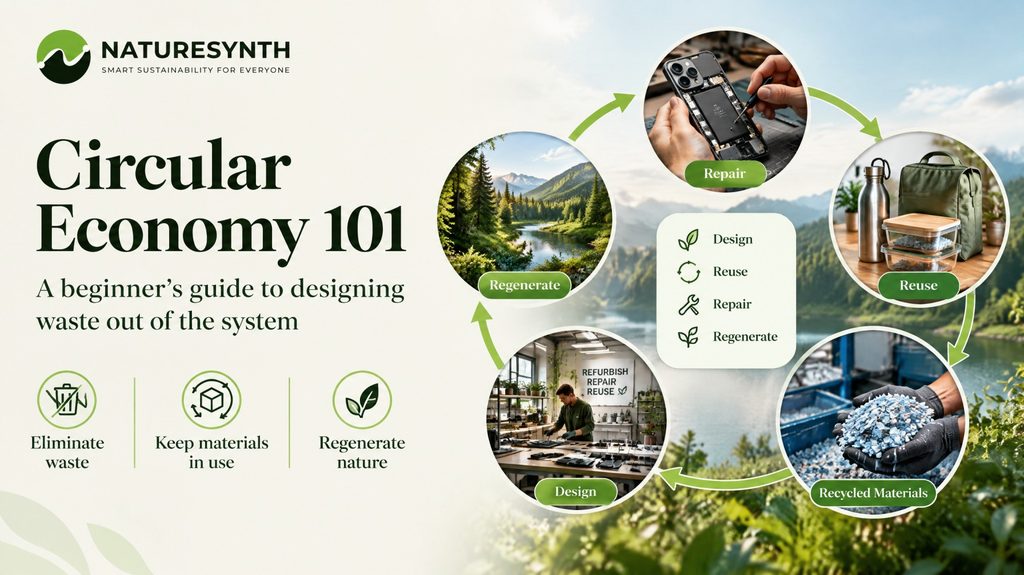
Most economic activity today follows a simple pattern: extract raw materials, make a product, sell it, and eventually throw it away. A circular economy challenges that pattern directly. Instead of a straight line from resource to waste, it aims to keep materials in use for as long as possible, cutting waste out of the system by design rather than managing it after the fact.
Why the Traditional Model Falls Short
The conventional “take, make, waste” model treats natural resources as if they were unlimited. However, resources are finite, and the waste generated by this linear approach carries real environmental and financial costs. Because of this, businesses and policymakers have increasingly looked for an alternative that does not depend on constant extraction and disposal.
A circular economy offers that alternative. According to the Ellen MacArthur Foundation, a leading global organization on the subject, a circular economy eliminates waste and pollution, circulates products and materials at their highest value, and regenerates nature. These three ideas form the foundation of the entire model.
The Three Core Principles
Eliminate Waste and Pollution by Design
In a circular economy, waste is not an unfortunate side effect to manage later. It is treated as a design flaw to eliminate from the start. This means products get designed for durability, repair, and eventual disassembly, rather than for a short lifespan ending in a landfill.
Keep Products and Materials in Use
Rather than discarding items at the end of their first use, a circular economy keeps materials circulating through reuse, repair, refurbishment, and recycling. A product’s value does not end when its first owner is done with it. In other words, an item can move through multiple useful cycles instead of a single, short one.
Regenerate Natural Systems
A circular economy goes beyond simply reducing harm. It actively works to restore natural systems, returning valuable nutrients to the soil and supporting biodiversity, rather than merely slowing down degradation.
What This Looks Like in Practice
Circular thinking shows up in more places than people often realize. A furniture company designing chairs that can be disassembled and repaired instead of replaced follows circular principles. So does a business that turns manufacturing byproducts into inputs for another process, rather than treating them as waste. Even simple choices, like favoring durable, repairable products over disposable ones, reflect the same underlying logic.
Why This Matters Beyond Environmental Impact
A circular economy is not purely an environmental initiative. It also carries real business logic. Materials kept in circulation reduce dependence on volatile raw material markets, and designing for durability often reduces long-term costs, even if upfront investment looks different from a purely linear approach.
Getting Started
Understanding circular economy principles is a useful starting point for evaluating how any business, regardless of size or sector, might rethink its relationship with materials and waste. You can find more general sustainability resources at naturesynth.com.