
What a Quick Scan Looks Like for a Nigerian Hotel or Hospitality Business
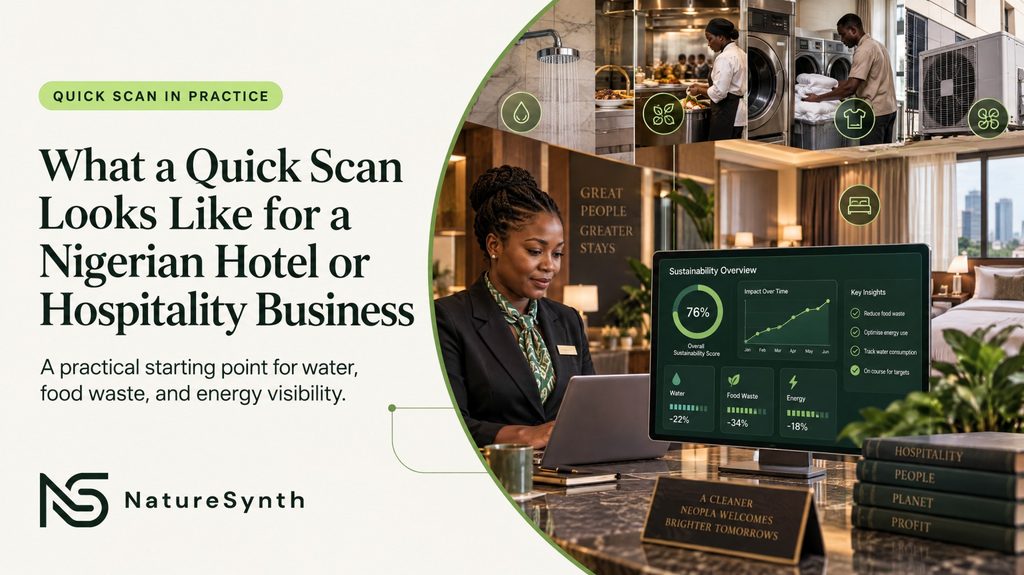
Hospitality carries one of the highest per-guest sustainability footprints of any sector, and most hotels have never measured it directly. For a Nigerian hotel or hospitality business, a Quick Scan surfaces a distinct set of patterns tied to guest-facing operations, not the production or retail issues other sectors face.
Why Hospitality Looks Different From Other Sectors
A hotel runs continuously, regardless of occupancy. Lighting, air conditioning, water heating, and laundry operate on a near-constant basis, often scaled for peak capacity even when actual occupancy runs lower. Because of this, a Quick Scan for hospitality asks about patterns that simply do not apply to a factory or a shop: water use per guest, food waste from kitchens and buffets, and energy consumption that rarely drops to zero even on quiet nights.
What the Questions Actually Look Like
A Quick Scan for hospitality typically probes areas specific to guest operations. This includes how water use is tracked across rooms, kitchens, and laundry, since these three areas usually account for the bulk of consumption. It also covers food waste, particularly from buffet-style service where overproduction is common but rarely measured. Energy use gets examined room by room and season by season, since cooling demands shift significantly with occupancy and weather. Finally, it looks at whether laundry and cleaning product sourcing has ever been screened for its own environmental footprint.
None of these questions require a sustainability specialist. They require honest input from whoever manages daily operations, often a facilities or operations manager.
What the Results Usually Reveal
A few patterns show up consistently in hospitality Quick Scans. Water use per guest frequently runs higher than regional benchmarks suggest it should, often due to aging fixtures or laundry practices nobody had revisited in years. Food waste from buffet service is almost always underestimated until it gets measured directly, since staff tend to notice only the most visible waste, not the cumulative total. Energy use rarely scales down proportionally with occupancy, meaning a half-empty hotel often costs nearly as much to run as a full one.
Why This Starting Point Matters
A Quick Scan does not resolve any of this by itself. It is self-reported and diagnostic, not a certified or independently reviewed assessment. What it provides is a documented, specific picture of where a hospitality business actually stands, replacing a general sense that “we probably waste some water and food” with real, structured findings.
Getting Started
If your hotel or hospitality business has never looked closely at water use, food waste, or energy patterns, a Quick Scan is built to surface exactly those gaps quickly. You can run one at naturesynth.com.