
What Does ESG Stand For? A Plain-Language Guide
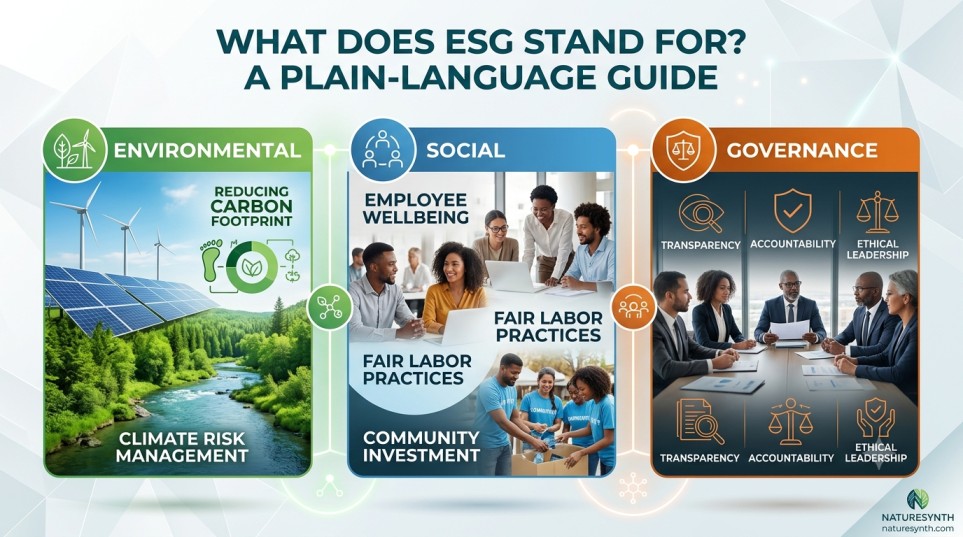
ESG shows up constantly in business news, investor reports, and boardroom conversations. However, the term rarely gets explained in a way that makes it immediately useful. ESG stands for Environmental, Social, and Governance, and understanding what each part actually covers matters more than memorizing the acronym itself.
Where the Term Comes From
ESG originated in the investment community as a way to evaluate risks that traditional financial statements simply do not capture. A company can look financially healthy on paper while carrying serious exposure to climate risk, poor labor practices, or weak oversight. Because of this, investors began looking beyond revenue and profit margins to assess a fuller picture of long-term stability.
According to the U.S. Securities and Exchange Commission’s Investor.gov, ESG investing evaluates companies based on their commitment to environmental, social, and governance factors. This framing signals something important: ESG is not just an ethical add-on. It is treated as a genuine measure of business resilience.
Breaking Down the Three Pillars
Environmental
This covers how an organization manages its physical impact on the planet. Greenhouse gas emissions, resource use, waste management, and exposure to climate-related risks like flooding or extreme heat all fall under this pillar. In other words, it asks whether a business is a responsible steward of the resources it depends on.
Social
This pillar looks at how an organization treats people, both inside and outside its walls. Employee wellbeing, fair labor practices, community relationships, and supply chain conditions all count here. As a result, social factors often reveal risks that never show up in a standard financial audit, such as labor disputes or reputational damage from poor treatment of workers.
Governance
Governance examines how a company is actually run. Decision-making structures, transparency, accountability, and ethical business practices sit at the center of this pillar. A business with strong environmental and social performance can still carry serious risk if its governance is weak, because poor oversight tends to undermine everything else eventually.
Why This Framework Keeps Gaining Traction
ESG is not simply a passing trend. Regulatory requirements around ESG disclosure continue to expand in multiple regions, and investors increasingly treat these factors as material to long-term financial performance, not separate from it. Meanwhile, customers and employees are paying closer attention too, which means ESG performance now shapes reputation well beyond the investment world.
A Framework Worth Understanding
Whether or not a business currently reports on ESG formally, the underlying questions are worth asking. How much environmental risk does the business carry? How well does it treat the people connected to it? How accountable is its leadership? These questions matter regardless of company size, and they are becoming harder to ignore with each passing year.
You can find more general sustainability and ESG resources at naturesynth.com.