
Why Most Companies Are Failing at Sustainability in 2026
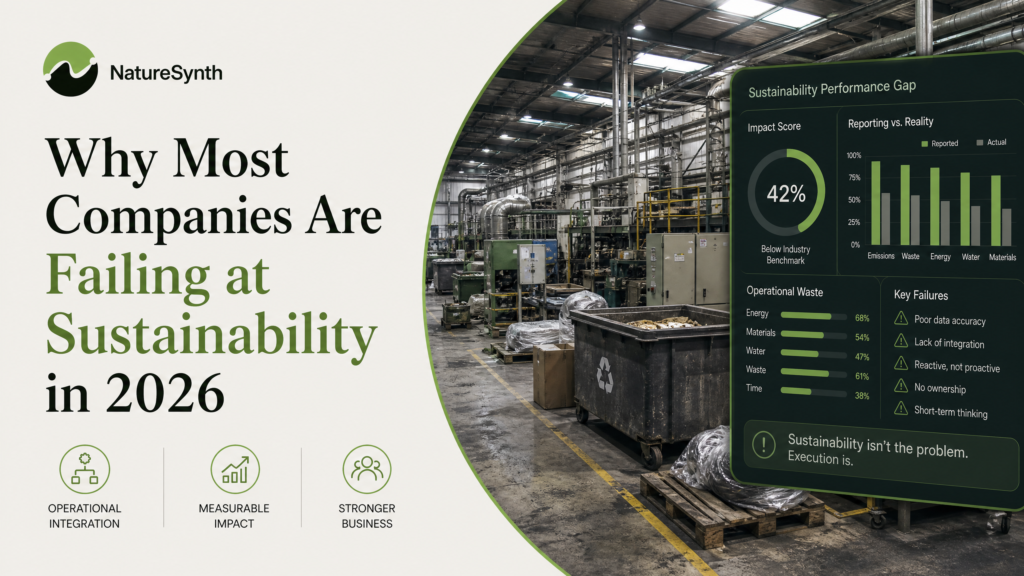
Many companies today claim to be sustainable. They publish reports, set targets, and communicate long-term environmental goals. Yet, despite these efforts, a growing number of organisations are still struggling to achieve real impact.
This raises an important question: why are so many companies failing at sustainability in 2026?
The answer is not that companies lack interest. The real issue is how sustainability is being implemented, measured, and prioritised.
Sustainability Is Still Treated as a Separate Department
One of the biggest problems is that many organisations still treat sustainability as a standalone function.
It often sits within a specific department rather than being integrated into core business operations.
This creates a gap.
While sustainability teams work on goals and reporting, operational teams focus on cost, production, and efficiency. As a result, sustainability becomes disconnected from daily decision-making.
When sustainability is not part of everyday operations, it struggles to create meaningful change.
Companies Focus on Reporting Instead of Results
Another major issue is the focus on reporting rather than impact.
Many organisations spend significant time preparing sustainability reports, frameworks, and disclosures. While transparency is important, reporting alone does not improve performance.
In some cases, companies focus more on how sustainability is communicated than how it is implemented.
This leads to a situation where progress looks strong on paper but remains weak in practice.
Real sustainability requires measurable operational change, not just documentation.
Lack of Clear and Measurable Metrics
Many companies struggle because they do not define clear, practical metrics for success.
Sustainability goals are often broad and difficult to track consistently.
Without specific indicators, such as resource efficiency, waste reduction, or operational improvements, it becomes difficult to measure real progress.
What cannot be measured is often difficult to improve.
This is one of the key reasons sustainability efforts fail to deliver consistent results.
Operational Efficiency Is Often Ignored
Sustainability is frequently discussed in environmental terms, but operational efficiency is sometimes overlooked.
Yet inefficiency is one of the largest sources of waste in business systems.
Energy waste, poor resource management, unnecessary processes, and workflow delays all contribute to unsustainable operations.
When companies fail to optimise internal systems, sustainability efforts lose effectiveness.
Improving efficiency is often one of the fastest ways to create real sustainability impact.
Short-Term Pressure Undermines Long-Term Goals
Many companies operate under strong short-term financial pressure.
This often leads to prioritising immediate performance over long-term sustainability objectives.
As a result, sustainability initiatives may be delayed, reduced, or deprioritised when financial conditions become challenging.
This creates inconsistency.
Sustainable progress requires long-term commitment, not occasional action.
Sustainability Is Still Not Fully Embedded in Decision-Making
In many organisations, sustainability is not yet part of core strategic decisions.
It is often considered after financial, operational, or production decisions have already been made.
This reduces its influence and limits its impact.
For sustainability to be effective, it must be included at the decision-making level, not treated as an additional consideration.
The Gap Between Strategy and Execution
Many companies have strong sustainability strategies but weak execution systems.
Plans are often well-designed but not fully implemented across all levels of the organisation.
This gap between strategy and execution is one of the most common reasons sustainability initiatives fail.
Without alignment between leadership, operations, and performance tracking, sustainability efforts remain incomplete.
What Successful Companies Are Doing Differently
Companies that are making real progress in sustainability share some common practices.
They integrate sustainability into daily operations.
They focus on measurable outcomes rather than broad promises.
They improve efficiency as part of sustainability goals.
They treat sustainability as a business function, not just a reporting requirement.
These companies understand that sustainability and performance are connected.
Where NatureSynth Fits
Many organisations struggle not because they lack intent, but because they lack clarity on operational inefficiencies.
NatureSynth helps businesses identify where waste occurs, understand operational patterns, and improve resource efficiency.
By focusing on practical improvements, businesses can move from intention to measurable progress.
Small operational changes often create meaningful long-term impact.
Conclusion
Most companies are not failing at sustainability because they lack commitment.
They are struggling because sustainability is not fully integrated into how businesses operate.
When sustainability becomes part of daily decisions, supported by clear metrics and efficient systems, real progress becomes possible.
The future of sustainability depends less on promises and more on execution.
Next Step
Look at your organisation today.
Ask:
Is sustainability part of daily decision-making?
Are we measuring real impact or only reporting it?
Are we improving systems or only setting goals?
The answers often reveal where real progress begins.