
How AI Is Changing Sustainability for Businesses in 2026
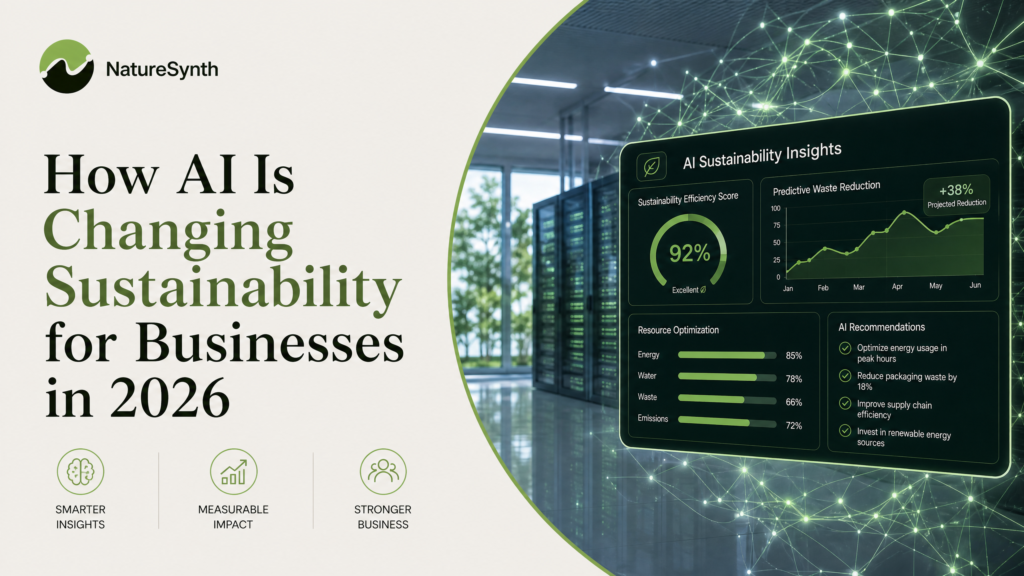
Many companies are now exploring AI sustainability for businesses because artificial intelligence is changing how organisations manage operations, reduce waste, and improve efficiency. Businesses no longer rely only on manual observations and assumptions.
Today, AI helps companies understand patterns, identify inefficiencies, and make faster decisions.
As sustainability becomes more practical and data driven, AI is becoming an important tool for business improvement.
Businesses Are Using AI to Understand Data Better
Modern businesses generate large amounts of information every day.
Energy use, resource consumption, production activities, customer behavior, and operational performance create valuable data.
The challenge is not collecting information.
The challenge is understanding it.
AI helps businesses process large amounts of information quickly and identify patterns that humans may overlook.
This allows businesses to make smarter and more informed decisions.
AI Can Help Identify Hidden Waste
Waste is often difficult to detect.
Some inefficiencies happen quietly inside operations and continue for long periods without being noticed.
Businesses may lose resources through unnecessary energy use, inefficient workflows, repeated mistakes, or poor resource allocation.
AI systems can analyze operational activities and identify unusual patterns.
This helps businesses discover problems earlier.
Small inefficiencies that previously went unnoticed become easier to identify.
Businesses Can Improve Efficiency Through AI
Efficiency remains one of the biggest priorities for modern businesses.
Companies want to reduce costs, improve productivity, and use resources more effectively.
AI can support these goals by helping businesses optimize operations.
For example, AI tools may help businesses predict demand, improve inventory management, reduce unnecessary processes, or monitor resource use.
Better information often leads to better efficiency.
AI Supports Smarter Sustainability Decisions
Businesses increasingly want measurable sustainability results.
AI helps by providing clearer insights.
Instead of relying only on assumptions, organisations can make decisions based on patterns and operational data.
For example, businesses may identify areas where energy use can be reduced or where operational improvements can create stronger results.
This makes sustainability more practical.
Businesses move from guessing to understanding.
Sustainability Is Becoming More Data Driven
The sustainability conversation is changing.
Businesses increasingly focus on measurable performance rather than broad promises.
As a result, data plays a larger role in sustainability strategies.
AI supports this shift because it helps organisations track patterns and measure progress more effectively.
Businesses want to know:
What is working?
What should improve?
Where are inefficiencies happening?
AI helps answer these questions.
Challenges Businesses Should Remember
AI creates opportunities, but businesses should also remain realistic.
Technology alone does not solve every problem.
Businesses still need clear goals, human oversight, and thoughtful decision making.
AI works best when businesses understand what they want to improve.
Strong systems and clear strategies remain important.
Technology supports improvement.
It does not replace business thinking.
Where NatureSynth Fits
As sustainability becomes more practical and data focused, businesses need clearer ways to understand operations.
NatureSynth helps businesses identify inefficiencies, improve resource management, and understand sustainability opportunities.
Businesses gain insights that support better operational decisions and measurable progress.
Small improvements often create meaningful long term impact.
Conclusion
AI is changing sustainability for businesses in 2026.
Businesses increasingly use artificial intelligence to identify waste, improve efficiency, understand operational patterns, and support better decisions.
The future of sustainability may depend not only on good intentions but also on smarter information.
Next Step
Ask yourself:
What information does your business already collect?
What patterns remain unnoticed?
Could smarter insights reveal hidden opportunities?
Better understanding often creates better decisions.